
Mastering your Connectivity HSSGamepad setup is the most effective way to ensure your competitive edge remains sharp during intense sessions. When you understand the technical nuances of your wireless controller connection, you stop fighting against hardware quirks and start focusing entirely on your gameplay mechanics. Poor performance often stems from invisible barriers between your peripheral and the gaming rig, rather than the device itself.
Achieving a consistent, high-performance link requires a methodical approach to signal management and software optimization. By addressing common bottlenecks like radio frequency congestion and driver misconfiguration, you can effectively eliminate jitter. This guide provides the technical roadmap necessary to stabilize your input stream and maintain fluid frame pacing across all your favorite titles.
Understanding the Mechanics of Wireless Controller Connection

Quick Answer: A stable wireless controller connection relies on maintaining a clear path for data packets between the HSSGamepad and your system’s receiver. Understanding this link is essential for preventing erratic behavior during high-stakes play.
The core of your gaming experience depends on how rapidly your controller communicates with the host system. Wireless technology utilizes specific frequency bands to transmit your button presses as digital packets.
When this transmission is interrupted, you experience input lag, which manifests as a delay between your physical action and the corresponding movement on screen. The HSSGamepad architecture is designed to minimize these interruptions through optimized protocols, but environmental factors often play a larger role than the hardware itself.
Every time you press a trigger or move an analog stick, the device encodes this data into a signal. This signal must travel through the air, navigate around physical obstructions, and be decoded by your computer or console.
If the signal integrity is compromised, the system may miss packets or experience frame pacing issues, making the game feel sluggish or unresponsive. Maintaining a direct line of sight between the transmitter and the receiver is the first step in mitigating these common connectivity hurdles.
Furthermore, internal controller settings often dictate how efficiently these signals are packaged. Ensuring that your HSSGamepad is operating within its intended HID profile compliance parameters allows the operating system to prioritize controller input over background tasks.
When you align your hardware settings with your system’s processing capabilities, you create a harmonious pipeline that supports high-speed data throughput. This is the difference between a frustrating, stuttering session and a precise, professional-grade experience.
Mitigating USB Dongle Interference and Signal Blockage
Quick Answer: USB dongle interference is frequently caused by proximity to high-speed data ports or metal chassis components that shield signals. Relocating your receiver is the fastest fix for persistent dropouts.
Many players plug their wireless receivers directly into the back of a PC tower, where the metal case acts as a Faraday cage, dampening the signal. This is a common mistake that leads to intermittent signal dropouts and inconsistent polling rates. Because your HSSGamepad transmits on a specific frequency, any physical barrier, especially dense metal or thick plastic, can cause the signal to bounce or degrade before it reaches the receiver.
To optimize your setup, use a short USB extension cable to bring the dongle away from the back of the computer. Placing the receiver on your desk, ideally with a clear view of your hands, significantly reduces the distance the signal must travel. This simple adjustment often resolves issues related to radio frequency congestion, as the receiver is no longer competing with the electromagnetic noise generated by motherboard components and high-speed data buses.
Consider the placement of other wireless devices as well. Wi-Fi routers, Bluetooth-enabled speakers, and even smartphones can introduce environmental noise that interferes with your controller’s signal.
If you notice your HSSGamepad struggling during peak usage times, it might be due to a crowded 2.4GHz spectrum. Moving your gaming station away from these sources or switching your home network to a 5GHz band can drastically improve the stability of your peripheral connection.
Optimizing Polling Rate and Input Latency
Quick Answer: A higher polling rate means your system checks for input more frequently, resulting in tighter responsiveness. Balancing this with system resources ensures your HSSGamepad performs at its peak.
The polling rate refers to how many times per second your computer asks the controller for an update on its current state. A low polling rate can lead to perceptible input lag, as your character might not react until the next cycle of the update loop. Most modern gaming peripherals, including the HSSGamepad, are designed to handle high polling rates, but the effectiveness of this feature depends on your device driver configuration and system settings.
When you configure your controller, look for settings that allow you to adjust the report rate. While a high rate is generally desirable, it does require more consistent processing power.
If your CPU is already under heavy load from demanding graphical settings, an excessively high polling rate can sometimes cause micro-stutters. Finding the “sweet spot” where your inputs feel instantaneous without overwhelming your system is a vital component of tuning your gaming environment for maximum efficiency.
Additionally, check for any background software that might be intercepting your controller data. Overlay applications, recording software, or poorly optimized drivers can introduce latency by trying to “hook” into your input stream. By keeping your system environment clean and ensuring that your HSSGamepad drivers are operating with priority, you minimize the overhead that sits between your physical input and the game engine’s response.
| Factor | Impact on Performance | Recommended Action |
|---|---|---|
| Wireless Distance | High (Signal Degradation) | Maintain under 3 meters |
| USB Dongle Location | Critical (Interference) | Use USB extension cable |
| Driver Version | Medium (Protocol Logic) | Perform regular firmware updates |
| Radio Frequency | High (Congestion) | Clear 2.4GHz interference |
Managing Firmware Updates and HID Profile Compliance
Quick Answer: Firmware updates provide essential patches for communication protocols, ensuring the HSSGamepad maintains full compatibility with modern operating systems. Ignoring these updates often leads to subtle, hard-to-diagnose connectivity bugs.
Manufacturers release firmware updates to address bugs, improve power efficiency, and refine the way the controller handles wireless handshakes. If you are experiencing strange behavior, such as buttons failing to register or sudden connection drops, checking for a firmware update should be your first troubleshooting step. These updates often improve HID profile compliance, which is the standardized way hardware talks to your operating system.
When your controller is fully compliant with the latest HID standards, your OS can identify and map inputs much faster. This reduces the time the system spends “translating” your physical movements into game actions. Without these updates, your controller might be forced into a generic driver mode, which is rarely optimized for the high-speed demands of modern competitive gaming.
To perform these updates, always use a wired connection to ensure the process isn’t interrupted. A connection failure during a firmware write can lead to a bricked device or corrupted configuration settings. Once the update is complete, perform a full restart of your gaming system to ensure the new driver configurations are loaded correctly and that any legacy settings from the previous version are purged from the registry.
Addressing Radio Frequency Congestion
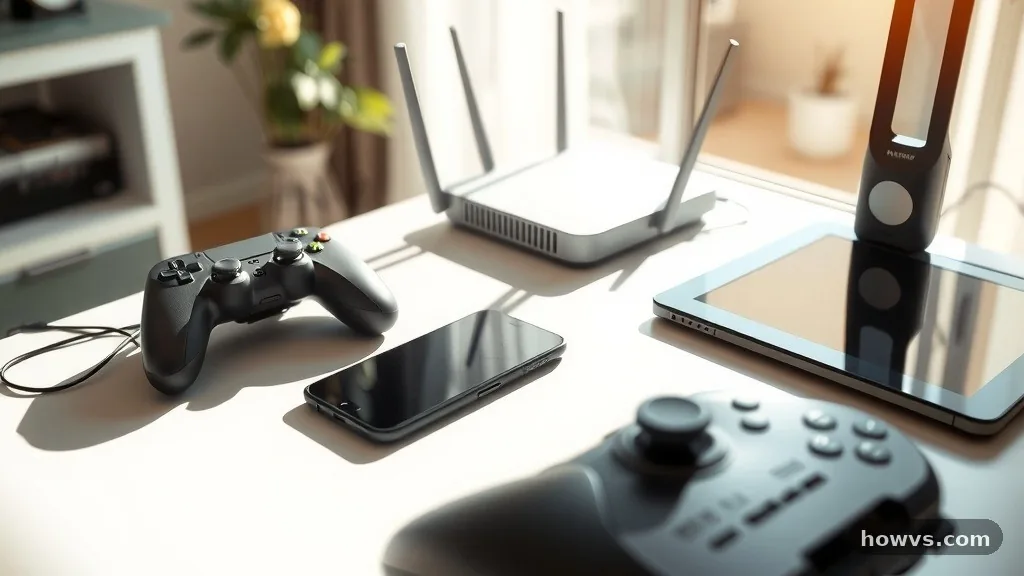
Quick Answer: Radio frequency congestion is the silent killer of wireless gaming performance, caused by too many devices operating on the same crowded bands. Identifying and isolating your HSSGamepad signal is key to stability.
The 2.4GHz frequency band is incredibly crowded in a modern home. Between your microwave, wireless internet, smart home devices, and cordless phones, the air is thick with electromagnetic noise.
When your HSSGamepad attempts to send a time-sensitive signal, it has to compete with this traffic. This collision of data packets is precisely what causes the “stutter” or “teleporting” movement you might see in online multiplayer games.
One of the most effective ways to mitigate this is to move your router’s wireless signals to the 5GHz or 6GHz bands, leaving the 2.4GHz band as free as possible for your peripheral devices. If you live in an apartment complex, you might even be picking up interference from your neighbor’s router. Using a spectrum analyzer app on your smartphone can help you identify which channels are the most congested so you can manually set your router to a cleaner frequency.
If you cannot clear the airwaves, consider moving your HSSGamepad receiver to a location that is physically shielded from your router. Even a few inches of distance or a solid object can sometimes act as a filter, dampening the conflicting signals while allowing your controller’s signal to remain clear. This requires a bit of experimentation, but the result is a significantly more stable and reliable connection during intense matches.
Advanced Input Mapping and Driver Configuration
Quick Answer: Customizing your input mapping and driver configuration allows you to tailor the HSSGamepad to your specific playstyle while bypassing system-level input smoothing. This creates a more direct and responsive control scheme.
Many gamers rely on default settings, but taking control of your device driver configuration can unlock better performance. By accessing the configuration utility for your HSSGamepad, you can adjust dead zones, sensitivity curves, and button remapping. When you optimize these settings, you reduce the amount of processing the system needs to do to interpret your inputs, which effectively lowers your overall latency.
Dead zone management is particularly important. If your dead zones are too small, the controller might register “ghost” inputs, which can confuse the game engine and lead to erratic behavior.
If they are too large, you lose the responsiveness you need for fine aiming. Finding the right balance ensures that every physical movement is intentional and accurately translated into the game world, which is vital for maintaining high-level performance.
Furthermore, consider disabling any “input acceleration” or “smoothing” features within the game or driver settings. While these can make the cursor feel smoother in a desktop environment, they are detrimental to competitive gaming because they artificially delay the input to make it feel more fluid. For the most precise control, you want a 1:1 mapping between your physical move and the screen action, which requires a clean, unadulterated signal path.
- Keep your firmware updated to ensure optimal HID profile compliance.
- Use a USB extension cable to position your receiver away from metal interference.
- Disable system-level mouse and controller acceleration for 1:1 input.
- Calibrate your dead zones to prevent accidental inputs and reduce lag.
- Shift other wireless devices to 5GHz bands to reduce 2.4GHz congestion.
- Regularly check your device manager for driver conflicts or outdated controller entries.
The Impact of Frame Pacing on Controller Feel
Quick Answer: Frame pacing issues can make a game feel laggy even if your HSSGamepad connection is perfect. Synchronizing your game engine performance with your input polling is essential for fluid gameplay.
It is easy to blame the controller when movement feels “off,” but often the issue is actually frame pacing. Frame pacing refers to the consistency of the time between each rendered frame.
If your game is dropping frames or rendering them unevenly, the controller’s input will feel delayed because the visual feedback isn’t keeping up with your physical actions. This creates a disconnect that mimics the feeling of a bad wireless connection.
To troubleshoot this, use a frame-time monitoring tool during your sessions. If you notice large spikes in frame times, your PC or console is struggling to keep up, and no amount of controller optimization will fix the perceived lag.
You may need to lower your graphical settings or cap your frame rate to a level your hardware can maintain consistently. A steady 60 frames per second with perfect pacing feels much more responsive than an erratic 100 frames per second that fluctuates wildly.
When the frame rate is stable, your HSSGamepad inputs are processed in sync with the visual output, creating a sense of “connectedness” that is vital for reaction-based games. Once you have established this baseline of visual stability, you can then fine-tune your controller settings to achieve that final layer of precision. Understanding the relationship between your display, your hardware, and your peripheral is what separates a casual player from a competitive enthusiast.
Troubleshooting Common Signal Dropouts
Quick Answer: Persistent signal dropouts are usually caused by power-saving features or physical hardware obstructions. Adjusting your OS power settings can often stop the system from “sleeping” your controller connection.
Nothing ruins a match faster than a sudden disconnect. If your HSSGamepad is dropping out, first look at your operating system’s power management settings.
Windows, in particular, has a tendency to put USB devices to sleep to save power, which can lead to momentary drops in connectivity. Navigate to your Device Manager, find your controller’s USB hub, and disable the option that allows the computer to turn off the device to save power.
Another common culprit is a damaged USB port or a failing cable. If you are using an extension, ensure it is high-quality and shielded.
Cheap, unshielded cables can actually act as antennas, picking up more interference than they filter out. If you suspect a hardware fault, try connecting the receiver to a different USB port, preferably one directly on the motherboard rather than a front-panel connector, which often has weaker signal integrity.
Finally, keep an eye on battery levels. Even if the controller seems to have power, a low battery can cause the internal transmitter to decrease its signal strength, leading to range issues and dropouts. Maintaining a regular charging schedule for your HSSGamepad ensures that the wireless radio always has the voltage required to maintain a strong, consistent link with the receiver, effectively preventing those frustrating mid-game disconnects.
Frequently Asked Questions
Why does my HSSGamepad feel laggy in certain games but not others?
Lag variation between games is often due to differences in how developers handle input polling and engine-level processing. Some games have built-in input smoothing or heavy post-processing that adds latency, whereas others prioritize raw input. You may need to adjust your in-game sensitivity settings or disable V-Sync to align the game’s responsiveness with your hardware capabilities.
Can I improve my controller’s polling rate through software?
While you cannot force a higher polling rate than what the HSSGamepad hardware supports, you can optimize your system to ensure the polling rate remains consistent. This involves updating your device drivers, removing background applications that poll USB devices, and ensuring your USB controller is not being throttled by power-saving settings in your OS.
What should I do if my controller disconnects every time I use my microwave?
This is a classic sign of 2.4GHz interference. Microwaves leak radiation that operates on the same frequency as many wireless controllers and Wi-Fi devices. To fix this, move your gaming setup away from the kitchen or switch your router and other devices to the 5GHz or 6GHz bands to clear the 2.4GHz spectrum for your controller.
Is a wired connection always better than wireless for the HSSGamepad?
A wired connection is technically the most stable because it eliminates the risk of radio frequency interference and signal dropouts. However, modern wireless protocols have advanced to the point where the latency difference is negligible for most players. If you are in a highly congested area, a wired connection provides a “set it and forget it” solution to signal stability.
Taking Control of Your Gaming Experience
Achieving a professional-grade gaming experience is rarely about purchasing the most expensive hardware; it is about mastering the environment in which your gear operates. By systematically addressing connectivity factors, from the physical placement of your USB receiver to the software-level adjustments of your device drivers, you create a foundation for consistent, lag-free performance. The HSSGamepad is a powerful tool, but its potential is fully realized only when you eliminate the invisible barriers that threaten signal integrity.
As you move forward, prioritize a clean 2.4GHz spectrum and ensure your system is tuned to process inputs without unnecessary overhead. Small, iterative changes often yield the most significant improvements in feel and reliability.
Start by relocating your dongle and checking for firmware updates, then observe how these adjustments impact your game. Once your connection is rock-solid, you can focus on what really matters—your skill, your strategy, and your performance on the virtual battlefield.